Station 1
How does an LLM learn?
Use one student character to separate training from generation: broad reading, teacher guided examples, and practice with feedback.
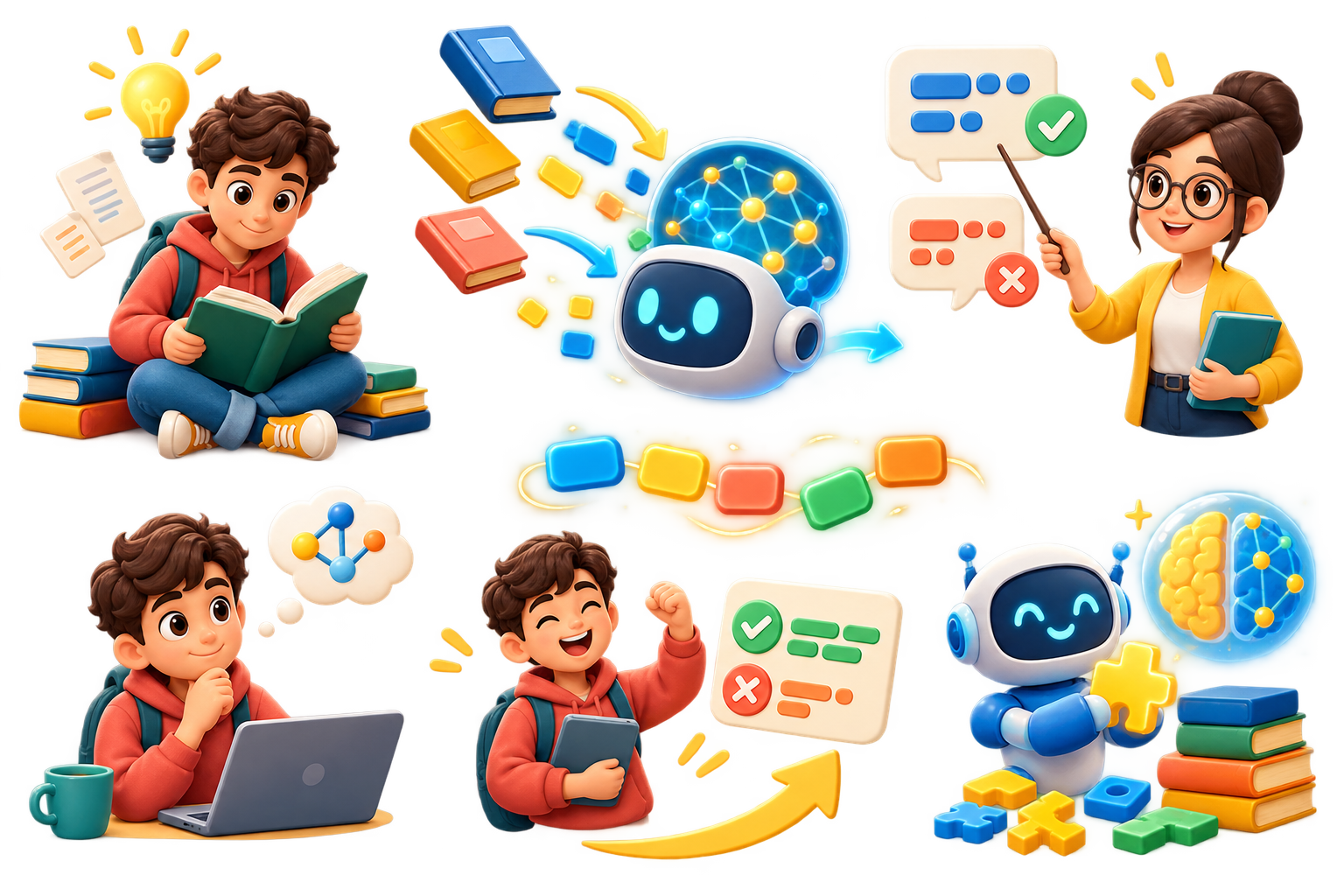
Pretraining
The student reads a huge library and gradually discovers patterns in language.
Large amounts of text -> Predict missing or next tokens -> Learn language patterns
Student learning
Read -> Learn how to answer -> Improve through feedback
LLM training
Pretraining -> Supervised Fine Tuning -> Reinforcement Learning
Station 2
Words become tokens
Begin with ordinary text. A language model does not receive the sentence as a single human-like thought; it receives a sequence of token pieces.
Artificial intelligence is changing education.
Press Tokenize to break the sentence into model-sized pieces.
Station 3
Tokens enter the context
The context is the text currently available to the model while it predicts the next token. It is working information, not human memory.
Context
The text currently available to the model when generating its next token.
Context Window
0 tokens
Station 4
A large neural network processes the context
The neural network idea from the previous lab now operates at enormous scale. Tokens flow through learned parameters and become probabilities.
Parameters
Values learned during training that encode patterns discovered from data.
The earlier learning station explains how pretraining, supervised fine tuning, and feedback shape these learned parameters.
Learned probabilities
Waiting
Station 5
Predict the next token
This is the central LLM move: given the current context, the model estimates which token is most likely to come next.
Current context
The capital of India is
Selected token
Delhi
Station 6
One token becomes many
A response appears because the selected token is added back into the context. Then the model predicts again. The loop repeats.
Context
Predict token
Add token
Repeat
Updated context
Generated response
AI
Station 7
The surprise: fluent text can still be wrong
If the model is predicting likely text, does that guarantee the answer is true?
Hallucination
A plausible sounding but incorrect or unsupported response generated by an AI model.
User asks
Who invented the solar-powered pencil in 1882?
"The solar-powered pencil was invented by Eleanor Marsh in 1882 after early experiments with miniature photovoltaic cells."
Factually unsupportedStation 8
The whole LLM mental model
Pretraining
Fine tuning
Feedback
Learned parameters
User context
Neural network
Next token probabilities
Selected token
Updated context
Generated response
Knowledge in parameters
Patterns learned during training. These may be useful, outdated, incomplete, or wrong.
Knowledge in context
Information currently provided to the model, such as your prompt, examples, or uploaded material.
Response
Learned patterns plus current context, expressed through repeated next-token prediction.